
ICHR statement on the eve of March 8 – International Woman’s Day
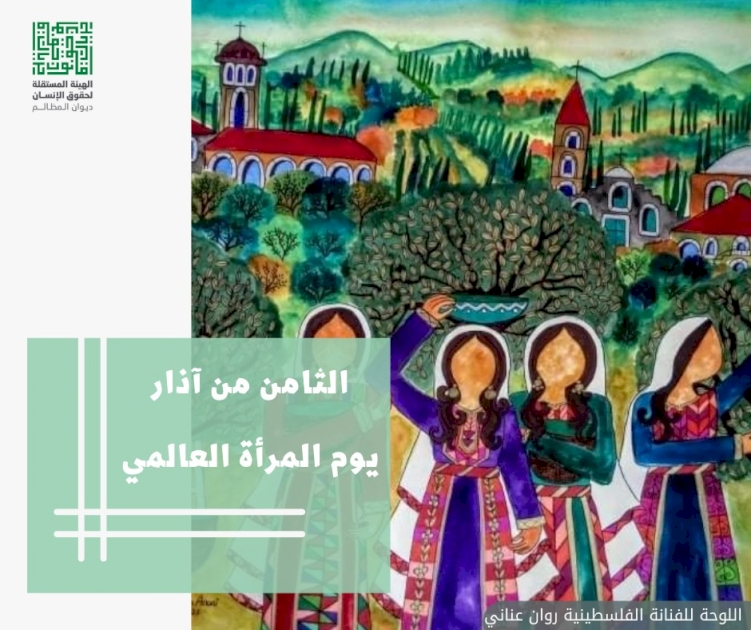
7 March 2023
11/2023
ICHR statement on the eve of March 8 – International Woman’s Day
On the occasion of the International Woman’s Day, which marks the 8th of March, the Independent Commission for Human Rights (ICHR) conveys its congratulations to all Palestinian women everywhere. On this day, the ICHR reiterates Palestinian women’s role and ability to support national and social struggle towards establishing the independent State, achieving equality, bringing about justice, and maintaining human dignity. The ICHR renews its call for making policies and enacting national legislation to protect, enhance the status of, and empower Palestinian women so that they can exercise their rights and freedoms on an equal footing with men and without any discrimination on the basis of gender or other discriminatory grounds prohibited by the Palestinian Basic Law and Declaration of Independence.
The International Women’s Day is marked while Palestinian women are experiencing extremely difficult and extraordinary circumstances. Targeting the Palestinian people, ongoing crimes committed by the Israeli occupying authorities have not spared women from murder, detention, and forced displacement. In 2022, the Israeli occupying army killed 18 Palestinian women and injured dozens of others. To date, 27 women and two girls continue to be held in Israeli prisons. Of these, two women are held under administrative detention (arrest without charge or trial). In spite of these abuses, Palestinian women carry on their struggle side by side with men to be free of the occupation and realise their right to self-determination, a prerequisite for women to access their full rights without discrimination. In this context, the ICHR calls upon the international community to give effect to the United Nations Resolution 1325 on Women, Security and Peace to ensure that the occupying Power is held to account for systematic crimes against the Palestinian people.
This occasion is marked against the backdrop of continued instances of discrimination against women in Palestinian society, formal and informal institutions, and effective national policies and regulations, hindering women from enjoying their fundamental rights and freedoms without discrimination. In particular, personal status, penal, and retirement laws continue to discriminate against women and impair their legal capacity in many aspects. As at the time of writing, although it was finalised, the Law on Family Protection against Violence has not been approved in spite of recommendations of the UN Committee on the Elimination of Discrimination against Women. In October 20221, in the context of a constructive dialogue with the official delegation of Palestine, the Committee stressed the need for expedited action to approve the Law on Family Protection against Violence, amend penal and personal status laws, and enact legislation that guarantees gender equality and brings an end to current legislative discrimination. Women’s participation in the labour market is another clear area of discrimination. The latest results of surveys released by the Palestinian Central Bureau of Statistics (PCBS) reflect a low proportion of women in the total labour force. Representing 19 percent of the total workforce, 32 percent of working women are employed in the informal sector. Of these, only 30 percent receive employment rights. These percentages stand in striking contrast to the hight enrolment rate of females in higher education in comparison to males. According to the PCBS, female students accounted for 62 percent of the total student population in the academic year 2021/2022. Women’s low political participation and holding of senior positions is also of note. Just 12 percent of all members of the Council of Ministers are women. Out of all 15 governor offices, only one woman holds the position of a governor. As few as 19 percent of all judicial posts are held by women.
In addition to manifestations of discrimination against women in social and economic spheres on the ground, the digital space does not constitute a place of safety for women. Cyberviolence perpetuates and sustains violence against women in the real world. According to the PCBS, 10 percent of married women and 12 percent of unmarried women experienced some form of cyberviolence in 2022.
In recent years, the ICHR has monitored a spike in the targeting of women’s associations and defenders of women’s rights by incitement and smear campaigns. These are threatened because they defend women’s rights and call for approving the Law on Family Protection against Violence, publishing and incorporating the Convention on the Elimination of All Forms of Discrimination against Women (CEDAW) into national policies, legislation, and processes. Regrettably, official authorities have often turned a deaf ear to these incitements and threats. They have not initiated legal action to provide protection or redress to defenders of women’s rights. In addition, investigation into incidents of violence against female journalists and protestors and abuse of privacy during demonstrations triggered by the murder of political opponent Nizar Banat in June 2021 continues to be suspended. No action has been taken to provide redress for victims and hold persons involved in these violations to account.
On this occasion, and on the basis of its role in promoting and defending human rights within all institutions of the State of Palestine and Palestine Liberation Organisation, the ICHR reiterates the need to put in place policies, enact regulations, and implement necessary national processes to protect women from violence and ensure that they fully enjoy their fundamental rights and freedoms enshrined in the Palestinian Declaration of Independence and Basic Law, as well as in the international human rights conventions, which the State of Palestine acceded to, first and foremost the CEDAW.
End