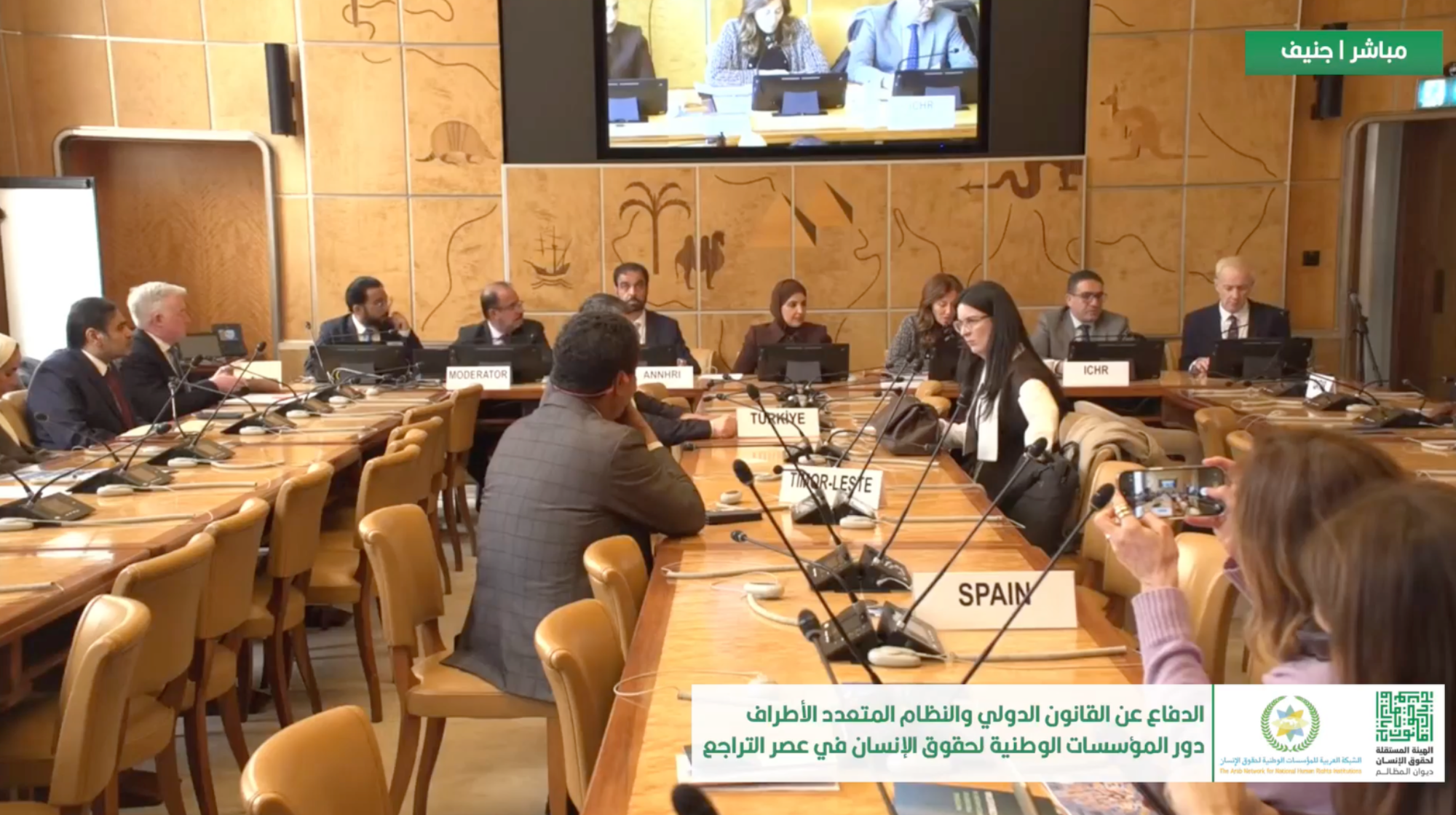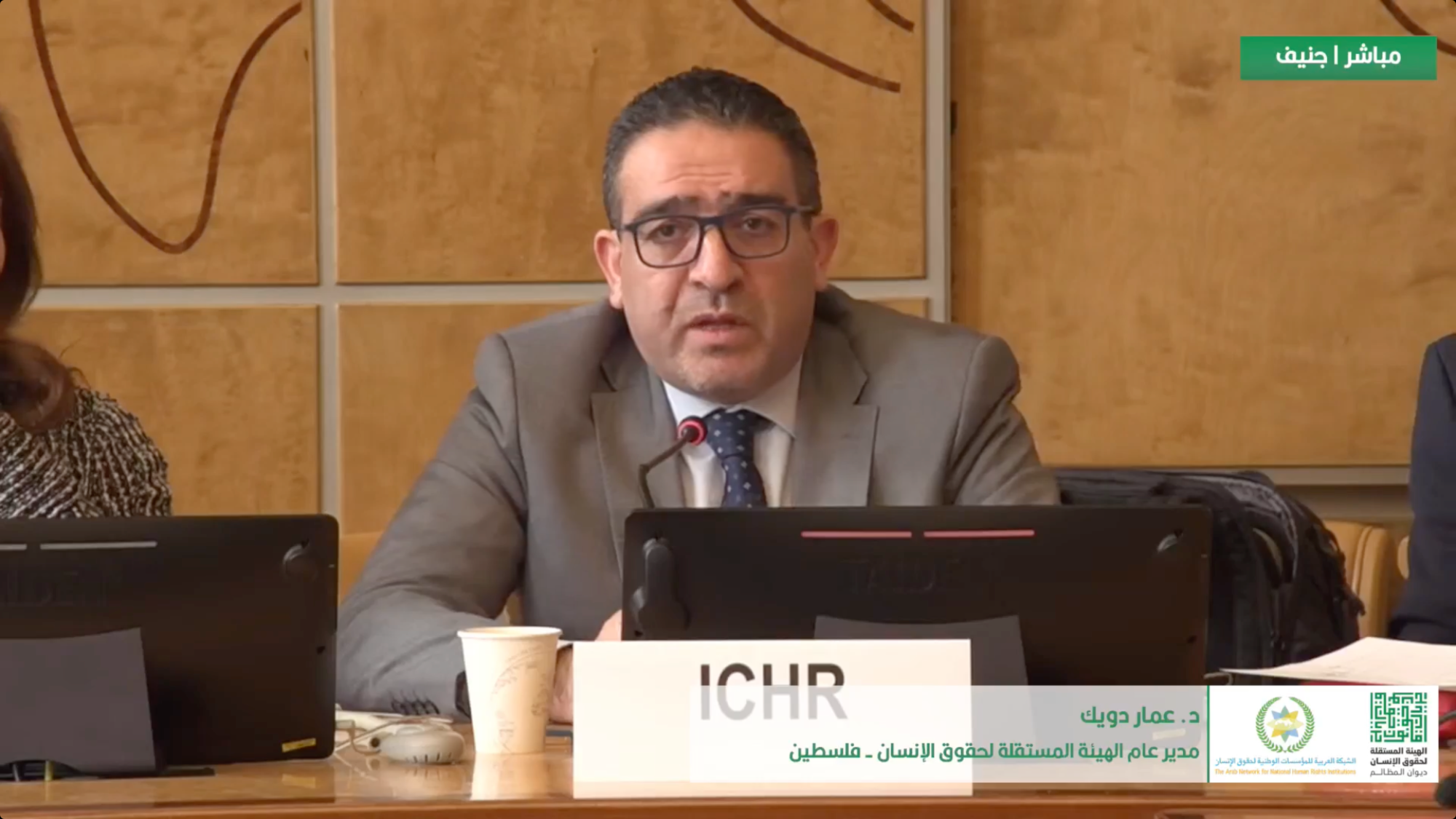
Dr. Ammar Dweik, on the sidelines of the Global Alliance of National Human Rights Institutions meetings in Geneva.
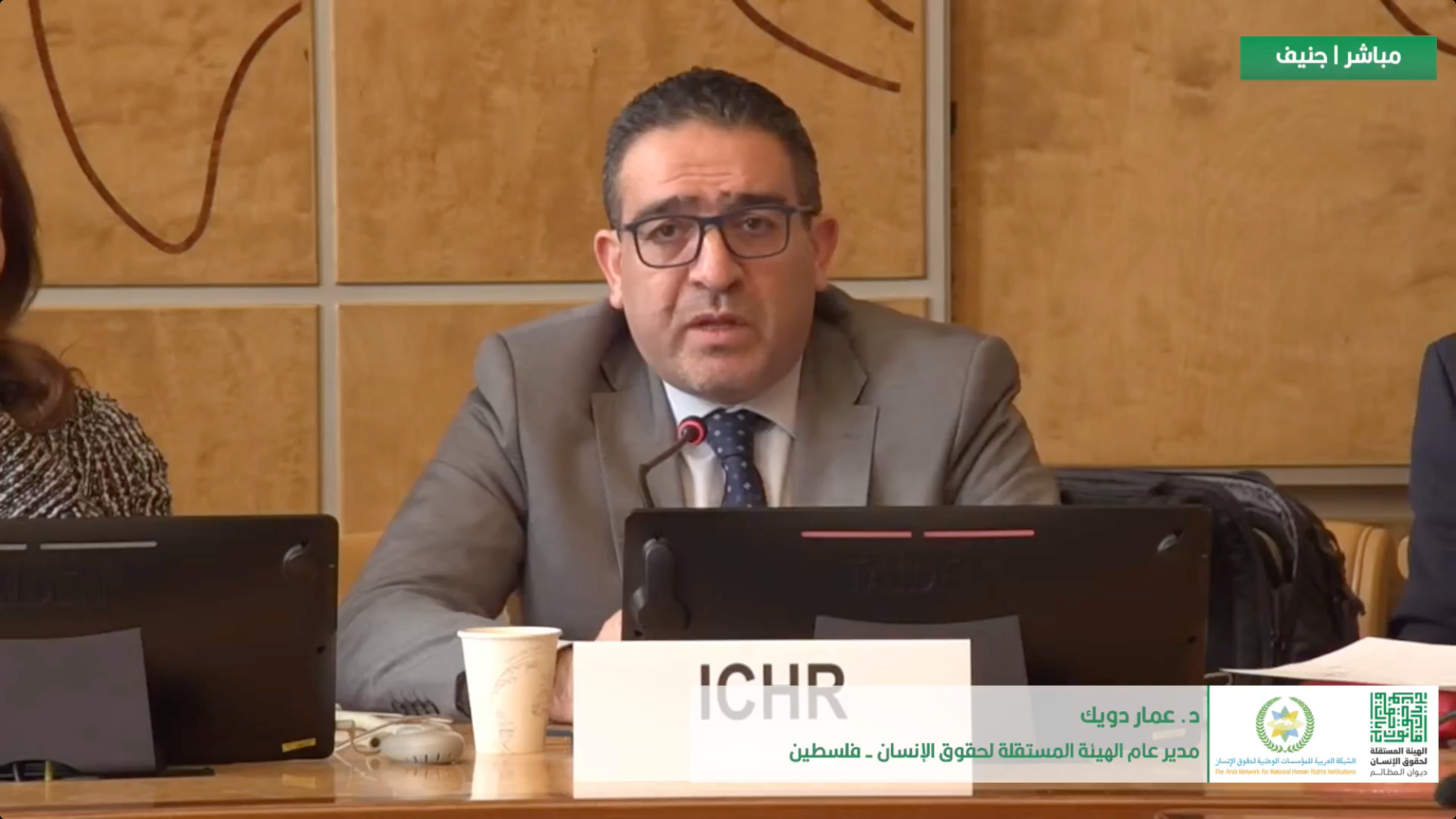
Speech by Dr. Ammar Dweik, Director General of the Independent Commission for Human Rights (ICHR), during a side event organized by the Arab Network of National Human Rights Institutions and the ICHR, on the sidelines of the Global Alliance of National Human Rights Institutions meetings in Geneva.
31 March 2026
Ammar Dwaik
Director General - Independent Commission for Human Rights – ICHR
Excellencies,
Distinguished colleagues,
Ladies and gentlemen,
It is an honor to address you today at this important side event, held alongside the GANHRI Annual Meeting 2026, here at the Palais des Nations.
I speak to you as a representative of the Independent Commission for Human Rights of Palestine — from a context where the challenges we are discussing are not abstract, but lived realities.
What we are witnessing today is not a temporary setback. It is a serious and dangerous shift in how international law and the multilateral human rights system are treated.
This system is being openly challenged — and in some cases, directly targeted.
We see this in the measures taken against UN mandate holders simply for doing their job. A clear example is the targeting of the SR on OPT Ms. Francesca Albanese, who has faced political pressure and sanctions for carrying out her mandate.
We also see this in legislative actions, including laws adopted by the Congress of the United States that authorize sanctions against the International Criminal Court and against individuals and entities that cooperate with it.
These measures have already been implemented. Sanctions have been imposed on judges and officials of the Court, as well as on Palestinian civil society organizations, simply for engaging in accountability efforts.
We are also witnessing direct targeting of UN agencies on the ground, including United Nations Relief and Works Agency for Palestine Refugees in the Near East (UNRWA), through political attacks, outlawing its activities by Israel, delegitimization campaigns, and funding cuts — despite its critical humanitarian role for millions of Palestinian refugees.
At the same time, we are witnessing a worrying decline in funding for the United Nations system — further weakening its ability to carry out its mandates effectively.
Distinguished colleagues,
These developments are not isolated. They are interconnected — and their impact is profound.
When institutions like the International Criminal Court are targeted, the message is clear: accountability is conditional.
When UN human rights mechanisms are undermined, oversight weakens.
When humanitarian agencies like UNRWA are weakened, protection on the ground collapses.
When funding is reduced, the entire system contracts.
And the consequences do not stop at the international level.
They directly affect the national level.
When governments see that international law can be ignored without consequence, respect for human rights domestically declines.
When international standards are weakened, national protections follow.
When accountability disappears globally, it erodes locally.
As Palestinians, we are not new to this reality.
We have long experienced the limitations — and at times, the failure — of the international system to enforce its own decisions. We have seen how international resolutions, including those issued by the International Court of Justice, can be disregarded without real consequences.
We have witnessed, firsthand, how international law has been applied selectively — undermining its credibility on the ground.
But what we are witnessing today is even more dangerous.
We are moving from a world of double standards
to a world of no standards at all.
A world where the only prevailing standard is power.
And this trajectory, if not confronted, leads us toward a system where the strong dominate the weak — a world that resembles a lawless space rather than an international community governed by rules.
Distinguished colleagues,
Despite all of this, we must be equally clear about one essential point:
The international system — with all its flaws and limitations — remains indispensable.
It is not perfect, but it is necessary.
It is not always effective, but it is foundational.
It represents a minimum framework that must be strengthened — not dismantled.
And here lies the critical role of National Human Rights Institutions.
NHRIs will be among the first to feel the impact of this erosion.
But they are also among the most important actors in resisting it.
Our responsibility today is clear.
First, we must speak out — clearly and firmly — against the targeting of international institutions and human rights mechanisms. Silence at this stage is not neutrality; it is complicity.
Second, we must engage our governments and demand clear positions in support of international law and the independence of institutions such as the International Criminal Court and mechanisms of the United Nations Human Rights Council.
Third, we must strengthen cooperation among ourselves — within GANHRI and through regional networks.
Fourth, we must deepen partnerships with civil society organizations to build broad coalitions capable of defending the international system and supporting those under attack.
Fifth, we must actively contribute to efforts aimed at reforming and strengthening the governance of the United Nations system — making it more effective, more accountable, and more equitable.
Excellencies,
Defending international law is not the responsibility of one region alone.
It is a shared obligation of countries of the Global South and the Global North alike.
Because rules are not only for the weak — they are essential for everyone.
Even the most powerful states ultimately depend on a system governed by law, not by force — especially in a world where power is constantly shifting.
If we allow these rules to erode, we will not be left with a more flexible system — but with a more dangerous one.
In closing:
We either defend international law — or accept a world ruled by power alone.
Thank you.